Wednesday, November 5, 2014

Watch > What if money were no object?


British philosopher and writer Alan Watts (1915-1973), author of the cult-classic The Way of Zen, played a key role in popularizing Eastern philosophy in the West, like John Cage had done, in the middle of the 20th century. In this short remix video, a fine complement to this omnibus of wisdom on how to find your purpose and do what you love, Watts asks the seemingly simple question of what you would do if money were no object:


New Information

Instructional Strategy

  • Questions & Cues
Learning Activity
  • Highlight & Deepen Understanding
In the comment section below respond to the following
  1. What was the highlight (or main point or your biggest takeaway) of the video?  
  2. What essential new understanding from the video would you share with your friends?
  3. What would you do if money was no object?

Interest Silhouette Event

Interest Silhouette Event
Add drama to your explorations

1 INTEREST SILHOUETTE GOAL SCORECARD > HTTP://GOO.GL/MQ2C9D


1 INTEREST SILHOUETTE PHOTO CHALLENGES > HTTP://GOO.GL/3YJMSW


1 INTEREST SILHOUETTE GANAG > HTTP://GOO.GL/UFMGF4

Digital Photography
A photography course that will increase your positivity through photographic technologies. 

Watch > How to Make Stress Your Friend


Stress. It makes your heart pound, your breathing quicken and your forehead sweat. But while stress has been made into a public health enemy, new research suggests that stress may only be bad for you if you believe that to be the case. Psychologist Kelly McGonigal urges us to see stress as a positive, and introduces us to an unsung mechanism for stress reduction: reaching out to others.


New Information

Instructional Strategy

  • Questions & Cues
Learning Activity
  • Highlight & Deepen Understanding
In the comment section below respond to the following
  1. What was the highlight (or main point or your biggest takeaway) of the video?  
  2. What essential new understanding from the video would you share with your friends?

Watch > How Meditation Can Reshape Our Brains


Neuroscientist Sara Lazar's amazing brain scans show meditation can actually change the size of key regions of our brain, improving our memory and making us more empathetic, compassionate, and resilient under stress.


New Information

Instructional Strategy

  • Questions & Cues
Learning Activity
  • Highlight & Deepen Understanding

In the comment section below respond to the following

  1. What was the highlight (or main point or your biggest takeaway) of the video?  
  2. What essential new understanding from the video would you share with your friends?

Watch > All it takes is 10 Mindful Minutes


When is the last time you did absolutely nothing for 10 whole minutes? Not texting, talking or even thinking? Mindfulness expert Andy Puddicombe describes the transformative power of doing just that: Refreshing your mind for 10 minutes a day, simply by being mindful and experiencing the present moment. (No need for incense or sitting in strange positions.)


New Information

Instructional Strategy
  • Questions & Cues
Learning Activity

  • Highlight & Deepen Understanding

In the comment section below respond to the following
  1. What was the highlight (or main point or your biggest takeaway) of the video?  
  2. What essential new understanding from the video would you share with your friends?

Hypothesize > Serenity - Reflection Connection Dialogue


Access Prior Knowledge:


Instructional Strategy

  • Cooperative Learning

Learning Activity


  • Hypothesize
  1. In the comment section below, hypothesize why the positive emotion 'Serenity' has been paired with the photographic technique 'Reflection'.
  2. +1 peer comments you believe are the strongest responses.  

Hypothesize > Gratitude - Shape Connection Dialogue


Access Prior Knowledge:

Instructional Strategy

  • Cooperative Learning

Learning Activity

  • Hypothesize
  1. In the comment section below, hypothesize why the positive emotion 'Gratitude' has been paired with the photographic technique 'Shape'.
  2. +1 peer comments you believe are the strongest responses.  

Personalize Goals > Interest Essential Questions


Instructional Strategy


  • Setting Objectives

Learning Activity


Tuesday, November 4, 2014

Ways To Develop Your Passions


One Moment Every Day - Cesar Kuriyama

One Moment Every Day


Step 1.
Answer in the comment section below
1- How do you remember things? 
(Do you... journal, keep a diary, scrap-book, status update...etc...)


Step 2.
Watch the video


Step 3.
Respond in the comment section
2- Why did he do this?
3- What were the unintended consequences of doing this?

Step 4.
Create > an image a day for 1 week (7 images total)

Step 5.
Post > with a caption (what day or date) and a brief explanation


Bonus:
You may appreciate the following video and seek ways to incorporate the idea into your life.


Interest Silhouette GANAG > http://goo.gl/UFMgF4

Interest Silhouette - Goal Scorecard


1. Log Progress > Interest Silhouette Goal Scorecard > http://goo.gl/yrV10b

2. Go to > File > Make a Copy


3. Rename it with your last name at the end (Interest Silhouette - Goal Scorecard - Kuepper)


4.  Keep track of the learning activities as we complete the Interest Album


5. Create > Take 5 pre-instruction silhouette photos 


6. Upload > Your images to a new G+ photo album titled Interest Silhouette


Interest Silhouette GANAG > http://goo.gl/UFMgF4


Monday, November 3, 2014

Generalize, Reflect & Publish - Serenity Reflection Album


Generalize, Reflect & Publish

Instructional Strategy

  • Providing Recognition

Learning Activity


Instructional Strategy

  • Providing Feedback

Learning Activity


Thursday, October 30, 2014

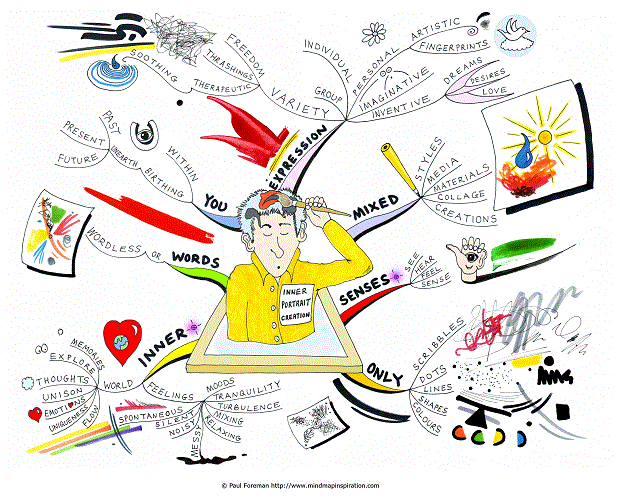
Understanding Structure Activity: Mind Mapping Art


Inner-portrait-creation.gif

Goal: Create a mind map using a visual art selected glossary term.

I will provide you with a visual art glossary term > http://goo.gl/v6SL5K .  Create a mind map artwork using your visual art glossary term as the catalyst.  Use branching structures, web structures or other structural forms expressing synonyms or free associations using words, drawings, colors or collage elements.  Continue mapping from the original term and the synonyms with more free associations that include terms and images.

Trigger Mechanisms:
Organize, branching, transition


Wednesday, October 29, 2014

ART:21 - Structure

Structure:
Artists explore how we organize life and the ways in which we capture knowledge and attempt greater understanding. Featuring artists Matthew Ritchie, Fred Wilson, Richard Tuttle, and Roni Horn, with an introduction by Sam Waterson and an original video artwork by Teresa Hubbard and Alexander Birchler.

Full Movie >

Chapter 1 >

Chapter 2 >

Chapter 3 >

Chapter 4 >

Chapter 5 >

Chapter 6 >

Chapter 7 >

Chapter 8 >

Chapter 9 >

Chapter 10 >

Chapter 11 >

Chapter 12 >

Chapter 13 >

Chapter 14 >

Chapter 15 >

Chapter 16 >

Summarize New Information > Structure


New Information:


Structure


Like the term design, the word structure is also a verb or noun.  Structure, in its basic sense, is the created unity of the parts and joints of entities.  It is a pattern of dynamic cohesion in which noun and verb, form and to form, are coexistent and interchangeable.  


As a verb, structure denotes modes of building, constructing, organizing and arranging things.
Paul Klee wrote that in art, structural design evolves through a process of metamorphosis, “The structural components, the way they originate and grow are the conditions.  The result evolves along the way.  Each phase during formation is the source of further inspiration, the basis on which to build.”  

As a noun, structure connotes something whose parts are joined together in some definite manner.  In art, any given element may be a structural unit or building block.  The way the structural units are assembled determines the degree of cohesiveness (or unity) in the completed object or composition. 


As an individual, in the comment section >
1. Summarize or Copy and past the main topic of the paragraph.
2. Choose a word that is new or you are unsure of its definition. Type the word and its definition.
3. Predict how you would do on a test about this new information.