Wednesday, February 19, 2014

Anthropomorphism

Gustave Courbet: The Desperate Man c.1843–1845http://www.finearttips.com/wp-content/uploads/2013/12/
Portrait-Face-Painting-Courbert-self-portrait.jpg
Anthropomorphism

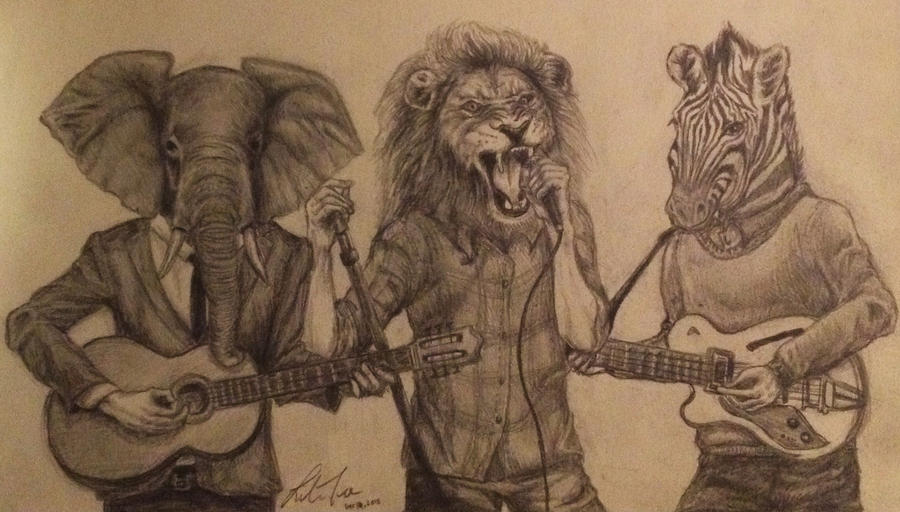
Concept:  Imbuing animals, plants, or objects with human qualities.


Catalysts:  Analogy, Transfer, Fantasize, Metaphor.


Studio1:  
In the medium of your choice, create a fully developed self portrait.
  • Emphasize dynamic composition using foreshortening or interesting perspectives.
  • Take multiple 'selfies' and we'll chose one.
  • Use contrast and value ranges to enhance drama and meaning.

http://farm4.staticflickr.com/3530/3801117805_a4aacf3406_o.jpg
http://www.conceptart.org/forums/attachment.php%3Fattachmentid
%3D1076699%26stc%3D1%26d%3D1286316709
Studio 2:
In the medium of your choice, create a fully developed still life image.
  • Define your inner personality with an animal, plant, or object.  
  • Research your horoscope, zodiac sign and Chinese year you were born.
  • Use accurate rendering techniques to portray an animal, plant or object.
  • Again emphasize dynamic composition, drama and meaning.

http://fc06.deviantart.net/fs71/i/2011/074/c/5/tiger_by_simone93-d3bp8b9.jpg
http://farm8.staticflickr.com/7311/8720668874_b06086c127_o.jpg 
Studio 3:
In the medium of your choice, create an anthropomorphic self portrait.

  • Compositional ideas include:
    • Create a playing card
    • Create a scene from a graphic novel or movie trailer
    • Create a ‘disney’ like cartoon

http://fc03.deviantart.net/fs70/i/2013/007/2/9/my_head_is_an_animal_by_liliannet-d5qr345.jpg

http://4.bp.blogspot.com/_9Z6WLg6fsxM/TPruOPI6D7I/
AAAAAAAAHO0/F9A2RVGxaoA/s1600/character%2Bkung%2Bfu%2Bpanda.jpg
http://3.bp.blogspot.com/_Hbcn71xGQz0/TEP9MD7FEmI/
AAAAAAAAANA/lv_IFvMqWh8/s1600/Panda%2BExpression%2BSheet.jpg

Tuesday, February 18, 2014

Formative Online Critiques

Formative Assessment is used to adjust teaching and learning while they are still happening.
The process provides feedback while the student is working.
  • It checks for understanding.
  • It guides decision making.
  • It collects evidence of the learning process.
Here is our Formative Online Critique >  http://goo.gl/sxkonN 
  1. Open the critique doc
  2. Go to File > Make a Copy and insert your name
  3. Make the doc public
  4. Paste a link to the doc in your Google+ Album Description


*Based on The Art of the Online Critique in Learning & Leading by Tiffany Roman and Matthew Callison

Friday, February 14, 2014

Westosha's 20% Project Proposals


Hey Teacher - Ask yourself >

  1. Am I offering students any autonomy over how and when to do this work?
  2. Does this assignment promote mastery by offering a novel, engaging task (as opposed to rote reformulation of something already covered in class)?
  3. Do my students understand the purpose of this assignment? That is, can they see how doing this additional activity contributes to the larger enterprise in which the class is engaged?


Drawing on four decades of scientific research on human motivation, Pink exposes the mismatch between what science knows and what business does—and how that affects every aspect of life. He demonstrates that while carrots and sticks worked successfully in the twentieth century, that’s precisely the wrong way to motivate people for today’s challenges.

When it comes to motivation, there’s a gap between what science knows and what business does. Our current business operation system – which is built around external, carrot-and-stick motivators – doesn’t work and often does harm. We need an upgrade. And the science shows the way. This new approach has three essential elements:
(1) Autonomy – the desire to direct our own lives;
(2) Mastery – the urge to get better and better at something that masters; and
(3) Purpose – the yearning to do what we do in the service of something larger than ourselves.
  1. Complete this proposal form with your group. > http://goo.gl/xxG7ov 
  2. Paste the URL to that form in the comment section of this post.
  3. Take a moment and watch Pink explain his findings about what really motivates us!

thanks +Kevin Brookhouser for letting me see how it's done!

Thursday, February 13, 2014

Make Time for Valentine's Day

Use Valentine's Day as an excuse celebrate the positive emotions that encompass LOVE.
1. Make a Valentine's Day Image or Card using the Sweethearts Theme in PicMonkey > http://www.picmonkey.com/ 
2. Look at the Posts below for inspiration and ideas

   
Robert Indiana - LOVE


The Power of Positive Thinking

We learned a lot developing our Positivity Portfolios - add this to it.

Plus: For those of you doing the Grumpy Cat Meme, this will help explain some of the underlying concepts.


Tuesday, February 11, 2014

Friday, February 7, 2014

Growth Mindset -vs- Fixed Mindset

Growth Mindset -vs- Fixed Mindset
We spoke about this often.  It is essential that you understand that a mindset is only an opinion or an attitude and not a fact.  A mindset can change.  Understand that Everyone has a Growth Mind but not everyone has a Growth Mindset.  Nobody has a Fixed Mind but some have a Fixed Mindset.

Create a Growth Mindset and your Growth Mind thrives!!!


Developing a Growth Mindset
Interview with Dr. Carol Dweck > http://goo.gl/7j711r

Growth Mindset = Grit > http://goo.gl/SYv7uq


Wednesday, February 5, 2014

Know ‘My’ Meme - Student Lead Studio Project


Challenge:


  • Know ‘My’ Meme - Student Lead Project


Goals:


  • Have your classmates demonstrate knowledge and understanding by being able to create a remix meme containing the essential elements of the presented meme.
  • Teach and instruct a meme project to the class that incorporates humor and wit along with an involved digital manipulation technique.


Remember, Understand & Apply:


  • Present background information on the meme.
  • Explore http://knowyourmeme.com/ - Internet Meme Database.  Know Your Meme is a website dedicated to documenting Internet phenomena: viral videos, image macros, catchphrases, web celebs and more.
  • Present a tutorial on the image manipulation techniques involved in creating your meme.


Analyzing & Evaluating:


  • Present a Thinglink > https://www.thinglink.com/ image analysis of your meme.
  • Tag - About Information
  • Tag - Origin Information
  • Tag - Spread Information
  • Tag - Notable Examples or Recent Images
  • Tag - External References
  • Tag - Essential Visual Design Elements
  • Tag - Image Manipulation Techniques

Creating:


  • Create a Re-mix of the meme using your own images that incorporate the digital manipulation techniques.
  • Publish your meme to our G+ Community Westosha Photo > http://goo.gl/34X4wo and our Know Your MEME Event > http://goo.gl/oju8Ak


Tuesday, February 4, 2014

ADV Photo Critical Thinking Image Analysis

ADV Photo Critical Thinking Image Analysis


Paul Strand
American, 1890–1976
Porch Shadows, 1916

Challenge:


Analyze historically significant photographs to develop an informed interpretation and evaluation.  


Remembering:


  • Tag - Who is the Artist? & What is the title of the artwork?  What media was used to create the artwork?


  • Tag - What year was the Artist born? & What year was the artwork created? How old was the Artist when the artwork was created? & How old is the artwork?


Understanding:


  • Tag - Placement:
    ...
    how the rule of thirds was or was not followed?
    ...how the visual weight balances or imbalances the composition?


  • Tag - Focal Point:
...what area of the picture commands your attention the most?
...how the focal point is emphasized? (contrast, placement…)
...how the focal point clarifies the message or meaning of the image?
  • Tag - Background:
...does the background distract the viewer away from the focal point?
...how the background contributes to the message of the image?
Analyzing:


  • Tag - Composition:  
...ways the image uses leading lines, vertical lines, or diagonal lines...?
...ways the image uses framing, contrast in color or shape...?
...the sense of depth in the image (deep, shallow, focused, blurred…)?
...how unity is achieved (repetition or common elements)?


Evaluating:


  • Tag - Evaluation: ...did the artist’s successfully express his/her intention or message?  
    ...what is the mood and how was it created?
    ...ways this image could be improved?


  • Tag - a significant quotation that describes the mood of the artwork and explain how the quotation as an analogy provides a deeper understanding of the artwork and its meaning.


  • Tag - a ‘soundtrack’ for this artwork on YouTube and explain why you choose that particular music for this particular artwork?  What or how the tempo / melody of the music similar to something in the artwork.


Creating:


Monday, February 3, 2014

Face Swap & Face Bomb MEME

Face Swap & Face Bomb MEME3


Know your Memes > http://knowyourmeme.com/memes/face-swapping

Project 7 - Sensory Analog - Image Analysis

Project 7 - Sensory Analog - Critical Thinking Image Analysis

Willem de Kooning
American, born Netherlands, 1904–1997
Excavation, 1950

Challenge:


Analyze abstract expressionist artwork to develop an informed interpretation and evaluation.  

Remember:


  1. Go to The Institute of Art of Chicago > http://goo.gl/P5jrjx and find an abstract expressionsist art work.


  1. Go to Thinklink >  www.thinglink.com and past the URL of the artwork.


  1. Tag - Who is the Artist? & What is the title of the artwork?


  1. Tag - What media was used to create the artwork?


  1. Tag - What year was the Artist born? & What year was the artwork created?


  1. Tag - How old was the Artist when the artwork was created? & How old is the artwork?


Apply: (Specify the intended meaning of the artwork.)


  1. Tag - a significant quotation that describes the mood of the artwork and explain how the quotation as an analogy provides a deeper understanding of the artwork and its meaning.


  1. Tag - a ‘soundtrack’ for this artwork on YouTube and explain why you choose that particular music for this particular artwork? What or how the tempo / melody of the music similar to something in the artwork.


Create:
 
Publish your Thinglink Image Analysis to our Community > Westosha ADV > http://goo.gl/qlrDZT


Hans Hofmann
American, born Germany, 1880-1966
Blue Rhythm, 1950

Sensory Analog Studio

Sensory Analog


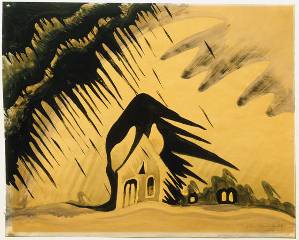
Charles Burchfield - The East Wind

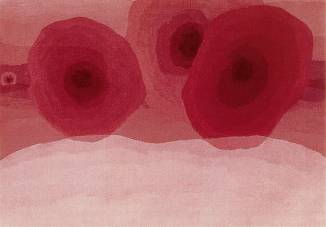
Arthur Dove -  Foghorns


Concept:  A sensory analog is a visual simile which refers to a sensory perception.


Catalysts:  Analogize, Fantasize, Symbolize, Transfer


Studio:  

  1. Stimulate your senses with music or; reminisce about the sensory pleasures of sounds, smells and visuals of a special holiday or; the touch of a loved one.
  2. While listening to music, do free association line doodles and shape abstractions.  
  3. Create a composition that is an abstract equivalent of the sensation.  
  4. Do not use pictures or images; rely only on lines, dots, shapes, forms, textures, colors… to portray your ideas.  

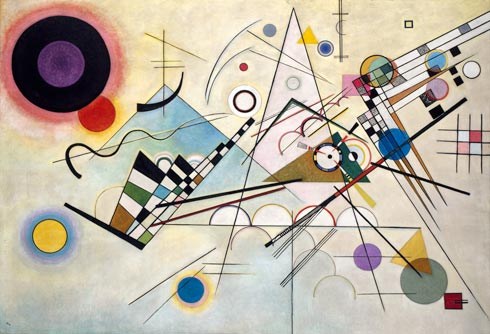
Wassily Kandinsky - Composition VIII

Research > Abstract Expressionism